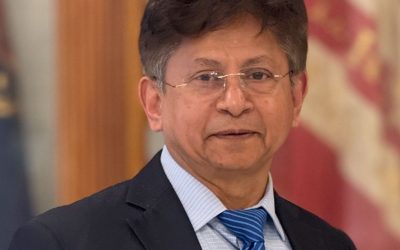
DEEPAK KUMAR ACHARJEE
প্রিন্ট
শনিবার, ২৭ ডিসেম্বর ২০২৫ সর্বশেষ আপডেট : ৯:৫৫ পূর্বাহ্ণ

On December 25, 2025, Bangladesh witnessed one of the most consequential moments in its political history as Tarique Rahman, Acting Chairman of the Bangladesh Nationalist Party (BNP), returned to Dhaka after nearly 17 years in exile. His homecoming was not merely personal or partisan; it marked a turning point that may redefine the nation’s political trajectory for a generation.
As Bangladesh heads toward the national election scheduled for February 12, 2026, the country finds itself suspended between revolutionary hope and profound uncertainty. With the Awami League (AL) effectively excluded from the electoral process following Sheikh Hasina’s exit from power on August 4, 2024, a political vacuum has emerged. This vacuum has triggered an intense struggle for dominance—primarily between the BNP and a reinvigorated Islamist bloc led by Jamaat-e-Islami.
Tarique Rahman’s arrival at Hazrat Shahjalal International Airport was met by an ocean of supporters, stretching for miles across Dhaka. The imagery was powerful and deliberate. Walking barefoot on Bangladeshi soil, Rahman projected humility, sacrifice, and an emotional reconnection with a homeland he left in 2008 under extraordinary political pressure.
The July 2024 mass uprising—led largely by students and ordinary citizens—fundamentally dismantled the long-standing two-family political duopoly dominated by the Zia and Hasina dynasties. While Tarique Rahman remains the natural leader for BNP loyalists, he now confronts a transformed electorate, particularly a politically awakened youth demanding systemic reform rather than inherited leadership.
Although the BNP currently appears to be the frontrunner in the 2026 election, a silent but intense rivalry has emerged with its former ally, Jamaat-e-Islami.
Since the fall of the Hasina government, Jamaat has worked aggressively to rebrand itself as a “clean” and disciplined alternative to the corruption associated with both the AL and BNP eras. Its student wing, IslamiChhatraShibir, achieved sweeping victories in university elections in late 2025, signaling a dramatic shift in youth political allegiance.
The National Citizen’s Party (NCP), formed by leaders of the July 2024 uprising, has aligned with Jamaat on key demands such as proportional representation. This emerging convergence threatens to fracture the BNP’s traditional majority and complicate the path to single-party rule.
The historical alliance between BNP and Jamaat was one of political convenience. That logic no longer holds. With Jamaat now sensing a realistic path to power, Tarique Rahman is increasingly perceived as the principal obstacle to an Islamist-led government.
There are credible concerns that radical factions within the Islamist camp view Rahman’s nationalist and comparatively moderate stance as incompatible with their vision of a more conservative “Islamic roadmap” for Bangladesh. In this volatile environment, personal security is no longer a peripheral concern—it is central to the political equation.
The February 2026 election is being watched closely by global and regional powers, given Bangladesh’s strategic importance in the Indo-Pacific.
Western media outlets, including The Economist and The New York Times, have already described Tarique Rahman as the “likely next Prime Minister.” Western governments emphasize the need for inclusive and credible elections. For them, a BNP-led government under Tarique Rahman represents a return to predictable democratic norms—provided he convincingly distances himself from the corruption allegations of his earlier political career.
Having backed Sheikh Hasina for over a decade, India now views the rise of Jamaat-e-Islami as a worst-case scenario, raising fears of renewed cross-border militancy and increased Pakistani influence. Despite lingering mistrust toward Tarique Rahman, Indian policymakers may ultimately see a BNP government as the lesser evil compared to an Islamist-dominated state. Rahman’s recent outreach to Hindu minorities and his avoidance of past pro-Pakistan rhetoric appear designed to reassure Indian concerns.
China continues to hedge its bets, prioritizing stability and the protection of its vast infrastructure investments. Beijing is expected to work pragmatically with any future government and has quietly maintained contact with BNP leadership over the past year.
Pakistan, meanwhile, sees a strategic opening. A Dhaka government less aligned with India could allow Islamabad to re-enter Bangladesh’s diplomatic and security calculus.
Tarique Rahman’s political future hinges on three critical factors: Personal Security: With the Awami League sidelined, the old “enemy of my enemy” logic no longer protects him. He has become the most visible—and therefore most vulnerable—figure in national politics.
The July Charter Referendum: Voters will simultaneously decide on the July Charter, a reform agenda that includes proportional representation. If adopted, the BNP may fall short of a parliamentary majority, forcing Tarique Rahman into a difficult coalition with either the NCP or Jamaat-e-Islami.
The Judicial Shadow: Although several cases against him were resolved after 2024, critics continue to invoke memories of the “Hawa Bhaban” era. To govern effectively, Tarique Rahman must demonstrate a reformed political identity—transparent, inclusive, and accountable.
Tarique Rahman has returned as a symbol of resistance and hope for millions. Yet he steps into a political landscape where old rules no longer apply. If he can survive immediate security threats and bridge the widening gap between the BNP’s traditional base and the reform-driven youth, he stands as the strongest contender for the premiership. Failure, however, could usher in a fractured parliament, prolonged instability, and renewed space for military or international intervention.
The six weeks leading to February 12, 2026, will not merely decide an election—they will shape the future of Bangladesh itself.
The writer is Editor and Publisher, The South Asian Times

Posted ৯:৫৫ পূর্বাহ্ণ | শনিবার, ২৭ ডিসেম্বর ২০২৫
nyvoice24 | New York Voice 24